.webp)
The steel weight calculation is a requirement in fabrication, shipping, costing and load planning, most particularly when you are ordering pipes, plates, or fittings on industrial projects. The correct weight formula for steel can help you and prevent the scenario of under-ordering, over-ordering, and unwarranted logistic expenses, whether you need to estimate lifting needs or compile a BOQ.
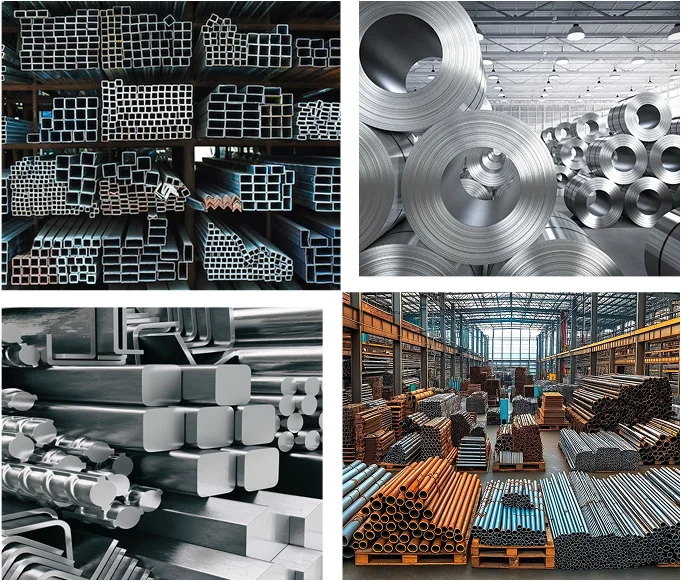
At USA Piping Solution, you’ll find a wide portfolio of steel products where correct weight estimation matters every day, such as Pipes & Tubes, Plates & Sheets, and Pipe Fittings & Flanges.
Steel Weight Formula: Full Guide to Weight Calculation
The most fundamental steel weight formula is based on volume and density:
Weight = Volume × Density (in consistent units).
Practically, simplified formulae of common steel shapes are used by the professionals to enable fast estimation. The trick is that these formulas are just shortcuts which are constructed out of the same density-based relationship.
The calculations are particularly helpful when purchasing industrial piping materials when it is necessary to:
- ordering the right quantity,
- planning transport loads,
- and estimating handling/ lifting weight on site.
When sourcing industrial piping materials, explore USA Piping Solution’s Pipes & Tubes range and find the weights which fit in schedules, lengths and grade requirements before you make the purchase.
The Weight Formula for Steel
1) General formula (density method)
Weight (kg) = Volume (m³) × Density (kg/m³)
A steel density reference is usually 7850 kg/m 3 (or 7.85 g / cm 3 ), which is a popular estimating density in most industry manuals on the topic of mild/carbon steel.
2) Plate/sheet shortcut
A commonly used shortcut for plates/sheets is:
Weight (kg/m) = Width × Thickness × 7.85 (with dimensions in mm, interpreted per the reference's method).
This is especially handy when ordering carbon steel sheets/plates for fabrication. For procurement and availability, USA Piping Solution groups these product needs under Plates & Sheets.
3) Inch-based formula (for quick estimates in imperial units)
For plate-type calculations in inches, one reference provides:
Weight = Width × Length × Thickness × 0.2836 (in inches)
The constant 0.2836 is used as a weight-per-cubic-inch factor (lb/in³) for steel in that guide.
Unit Weight of Steel
Unit weight of steel (density / specific weight) is required before you can use any steel weight calculation. One cites typical values of unit weights of mild steel in various units including:
- 7850 kg/m³
- 7.85 g/cm³
- 78.5 kN/m³
- 489.84 lb/ft³
These values can assist you to translate volume into mass/weight based on the units that your drawings and purchase orders are in.
Weight of Steel Bars Formula
For round bars, one reference presents a fast "site-friendly" approach:
Weight (kg/m) = D² / 162 (where D is diameter in mm).
Another reference presents an equivalent style shortcut for round bars:
Weight (kg/m) = (D² × 0.006162) (D in mm).
The two practices are applied in quick estimation, and both are based on the same underlying density principle.
Unit Weight of Steel Bars
The following is a unit weight table of size presented in the reference (useful when you want to find a Steel weight calculator in kg approach quickly without having to go through the entire calculation):
|
Diameter (mm) |
Unit Weight (kg/m) |
Unit Weight (kg/ft) |
|---|---|---|
|
6 |
0.222 |
0.067 |
|
8 |
0.395 |
0.120 |
|
10 |
0.617 |
0.188 |
|
12 |
0.89 |
0.270 |
|
16 |
1.58 |
0.480 |
|
20 |
2.47 |
0.751 |
|
25 |
3.86 |
1.174 |
|
32 |
6.32 |
1.925 |
The Weight of Steel Beams and Structures
The number of variables that are normally necessary in beams and structural sections is higher than that of a simple bar or plate. The weight depends on:
- beam size/shape (I/H sections differ),
- length,
- steel grade and density,
- additional loads,
- and connections/joints.
In section profiles, standard, or weight charts are often used by engineers in real projects to eliminate cross-sectional values that have to be hand-calculated.
You can check to match material ordering by checking: if your project has structural pipework and connection components:
- the pipe category under Pipes & Tubes,
- and connection components under Pipe Fittings & Flanges.
Weight of Steel Plate and Sheet Metal
In the case of plates and sheets, the volume (Length x Width x Thickness) of the plate and sheets multiplied by the unit weight of the steel is simple to compute using the density-based approach. In the case of inches, the reference recommends the 0.2836 constant method of quick approximation.
Weight of Steel Pipes
The calculation of steel pipe weights is usually done using OD of pipes, wall thickness (or schedule) and length- thereafter the density is applied. This is particularly relevant to industrial projects where the freight costs and crane scheduling are fueled by the tonnage in pipes.
The Bottom Line
The weight formula for steel is crucial to making proper steel weight calculation in bars, plates, beams, and pipes. When you use the right steel weight formula and right unit weight of steel on a regular basis, you enhance the cost estimation, transport planning as well as general project control.
For industrial-grade supply across piping systems and fabrication requirements, explore our:
Our Blog List
Application Industries
 Boilers
 Heat Exchangers
 Power Plants
 Steam Piping
 Refineries
Drop us a line
We respects customer privacy and ensures absolute confidentiality of any information that is given to us.