
Nickel Alloy Pipes & Tubes
Nickel alloy pipes and tubes are widely used in industries that have a high demand of extreme levels of resistance to corrosion, oxidation, and high temperatures. These alloys are also high in the content of nickel with other elements such as chromium, molybdenum, copper and iron to improve mechanical strength and long-term durability. These properties have led to popular use of nickel alloy pipe and nickel alloy tube systems in chemical processing, marine engineering, oil and gas operations, power generation, and heat exchanger applications where the materials are needed to operate in hostile environments.
USA Piping Solution provides a large variety of Nickel Alloy Pipes and tubes that are produced as per the global standards like ASTM, ASME and ANSI. Our nickel alloy pipe and nickel alloy tube products come in seamless and weldable varieties in different sizes and wall thickness to suit different industrial needs.
Types of Nickel Alloy Pipes & Tubes
We manufacture and supply nickel alloy pipes and tubes in the following grades. Each grade is engineered for specific environments and performance requirements:
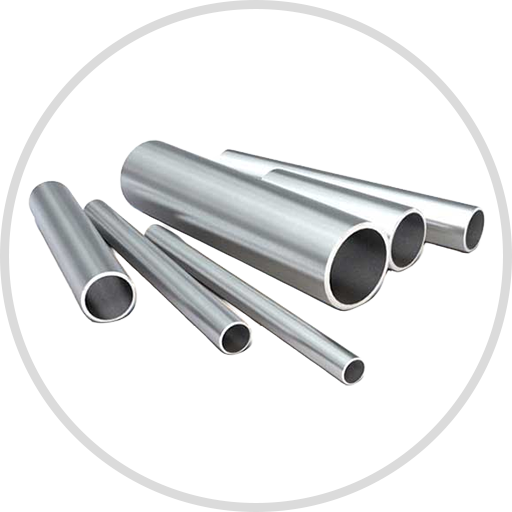
Nickel 200 Pipes & Tubes
View products →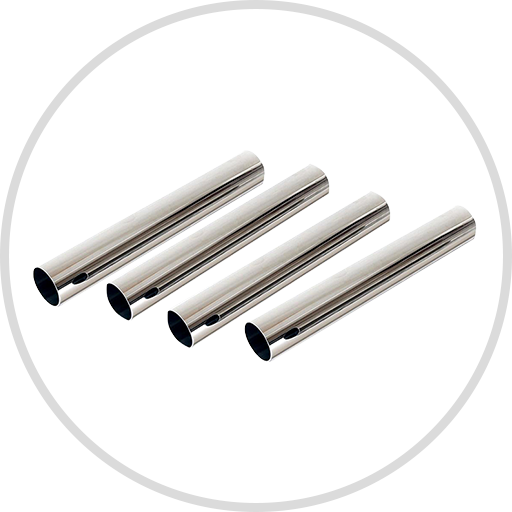
Nickel 201 Pipes & Tubes
View products →Nickel Alloy Pipes & Tubes Specifications
| Specification | Details |
|---|---|
| Standards | ASTM B161, ASTM B163, ASTM B725, ASTM B729 |
| Pipe Type | Seamless / Welded / ERW / Fabricated |
| Size Range | 1/8" NB to 48" NB |
| Wall Thickness | SCH 5 to SCH XXS |
| Length | Single Random, Double Random, Custom Cut Length |
| End Type | Plain End, Beveled End, Threaded |
Chemical Composition of Nickel Alloy Tubes
| Grade | Ni | Cr | Fe | Mo | Cu |
|---|---|---|---|---|---|
| Nickel 200 | 99.0 min | - | max 0.40 | - | - |
| Nickel 201 | 99.0 min | - | max 0.40 | - | - |
Mechanical Properties of Nickel Alloy Pipes & Tubes
| Grade | Tensile Strength (MPa) | Yield Strength (MPa) | Elongation (%) |
|---|---|---|---|
| Nickel 200 | 380 | 100 | 40 |
| Nickel 201 | 345 | 80 | 40 |
These mechanical properties ensure that Nickel Alloy Pipes & Tubes maintain strength, ductility, and structural stability when used in demanding industrial piping systems.
Types of Nickel Alloy Pipes & Tubes by Manufacturing Process
Seamless Nickel Alloy Pipes
Manufactured without weld joints for high-pressure and high-temperature applications requiring maximum structural integrity.
Welded Nickel Alloy Pipes
Produced by rolling and welding metal sheets; suitable for lower-pressure systems and large-diameter piping.
ERW Nickel Alloy Pipes
Electric resistance welded pipes offering consistent quality and dimensional accuracy for structural and industrial use.
Fabricated Nickel Alloy Pipes
Custom-manufactured to precise project specifications, accommodating non-standard dimensions and complex industrial requirements.
Applications of Nickel Alloy Pipes & Tubes
Nickel alloy pipes and tubes are widely used in demanding industrial environments. Nickel-based alloys are preferred because they provide excellent resistance to corrosion, oxidation, and extreme temperatures in aggressive environments.
- Chemical processing plants
- Offshore oil and gas pipelines
- Marine engineering systems
- Power generation plants
- Heat exchangers and condensers
- Petrochemical processing facilities
- Pharmaceutical manufacturing plants
Advantages of Nickel Alloy Tubes & Pipes
- Outstanding corrosion resistance in both acidic and alkaline environments
- High temperature strength retained up to elevated service temperatures
- Excellent resistance to oxidation and scaling
- Long service life in harsh, chemically aggressive environments
- Good weldability and fabrication properties for complex assemblies
FAQs About Nickel Alloy Pipes & Tubes
What are nickel alloy pipes used for?
Nickel alloy pipes are used in industries such as oil and gas, chemical processing, marine engineering, and power generation where corrosion resistance and high-temperature strength are essential. They are also widely used in heat exchangers, pharmaceutical plants, and offshore piping systems.
What standards are used for nickel alloy pipes?
Common standards include ASTM B161, ASTM B163, ASTM B725, ASTM B729, and ASME equivalents depending on the alloy grade. Our products comply with these internationally recognized specifications for seamless and welded nickel alloy piping.
What is the difference between Nickel 200 and Nickel 201?
The primary difference is carbon content. Nickel 200 has up to 0.15% carbon, while Nickel 201 is limited to 0.02% carbon. This lower carbon in Nickel 201 prevents embrittlement at temperatures above 315 C, making it the preferred choice for high-temperature caustic applications.
What size range is available for nickel alloy pipes?
USA Piping Solution offers nickel alloy pipes and tubes ranging from 1/8" NB to 48" NB with wall thicknesses from SCH 5 to SCH XXS. Custom dimensions and cut lengths are also available on request.