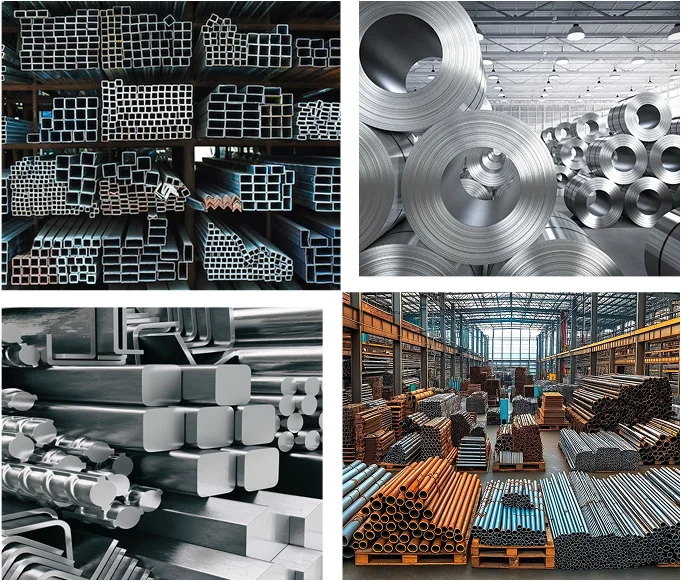
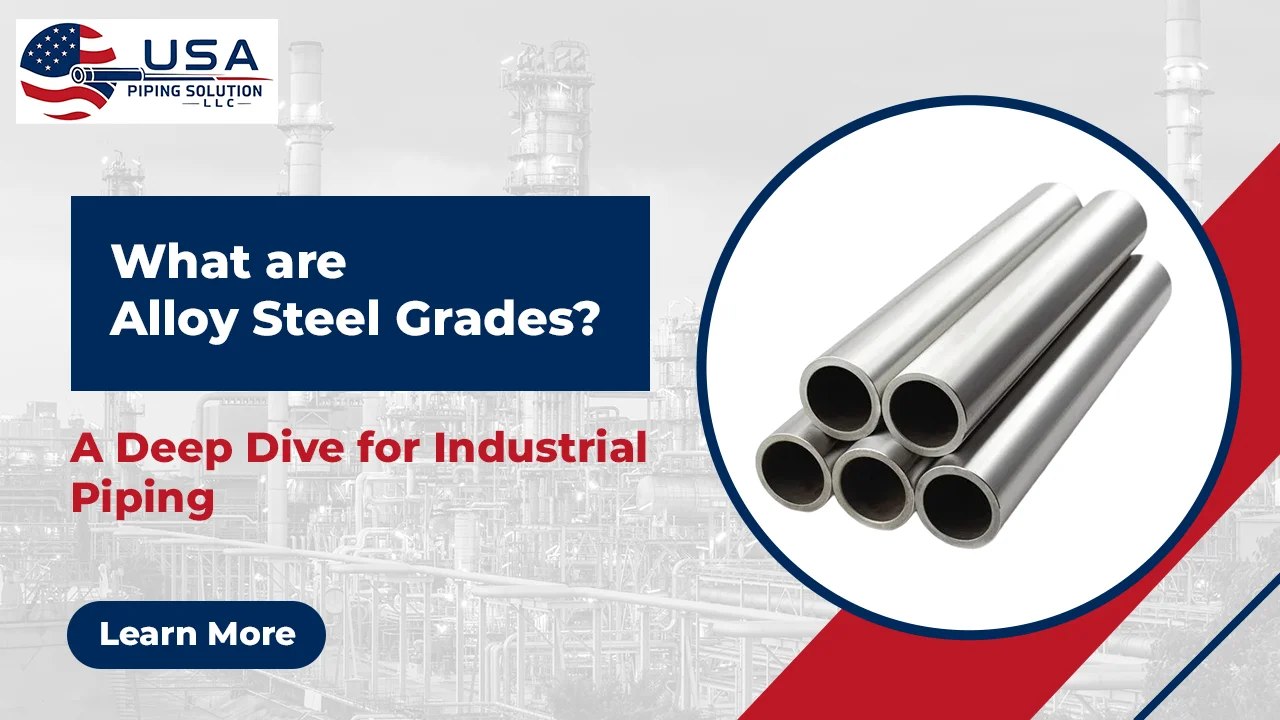
Alloy steel grades form the foundation of contemporary industrial construction especially in the demanding piping systems, pressure vessels and high temperature equipment. Compared to ordinary carbon steel, Alloy steel is developed by adding certain elements with exact introduction of some elements such as chromium, molybdenum, nickel and vanadium. These regulable additions essentially change the properties of the steel and break open the abilities that are necessary in challenging environments of operation.
There is more to it than simply knowing the material; the knowledge of these grades would form the basis of safe, long lasting and economically viable material specification to any project of critical nature.
What Defines Alloy Steel?
An Alloy steel is simply a ferrous metal cast with a considerable amount of one or more alloying elements (other than carbon) which are added intentionally to improve a particular mechanical or chemical property. The outcome is a higher performance metal as compared to plain carbon steel and can be said to have higher strength, hardness, resistance to corrosion and can withstand extreme temperatures.
American Society of Testing and Materials (ASTM) and Society of automotive engineers (SAE) create and uphold the complete number system used to identify these alloy steel grades.
The Key Alloying Elements and Their Influence
The behavior of alloy steel is strictly related to its composition and the concentration of added elements. The alloy steel composition dictates the material's properties, such as strength, ductility, hardness, and resistance to corrosion. The following are the functions of the most common alloying components in steel:
|
Element |
Effect on Steel Properties |
|
Chromium (Cr) |
A primary element added for corrosion resistance (over 10.5% creates stainless steel) and improved oxidation resistance at elevated temperatures. Also contributes to hardenability and wear resistance. |
|
Molybdenum (Mo) |
Boosts strength and hardness. Most crucially, it enhances creep resistance, which is the metal’s ability to resist deformation under stress at high temperatures. |
|
Nickel (Ni) |
Increases overall strength and imparts exceptional toughness, especially at low (cryogenic) temperatures. It also aids in corrosion resistance. |
|
Manganese (Mn) |
Improves surface hardness and resistance to shock and deformation (strain). It is a vital deoxidizer in steelmaking. |
|
Vanadium (V) |
Increases tensile strength and toughness, providing superior wear resistance. |
Classifying Alloy Steel Grades
Alloy steel grades can be widely categorized with regards to the actual amount of alloying elements available:
Low-Alloy Steel; The concentration of alloying elements in low-alloy steels is usually less than 5%. These steels are characterized by superior mechanical properties and in most cases can be readily welded. They are common where medium strength and enhanced toughness is needed like in select pressure vessel plates or structural tubing.
High-Alloy Steel: The overall concentration of alloying elements is more than 5% in high-alloy steels. The most widespread is of stainless steel that should include a minimum of 10.5% Chromium to be called such. These alloys are commonly chosen when there are applications of high corrosiveness or extremely high temperatures.
Focusing on Alloy Steel ASTM Grades for Industrial Piping
In the case of piping solutions provider, the most significant classification is under the standards that are put forward by ASTM International. These requirements include chemical composition, mechanical tests, heat treatment and tolerance levels of different products.
In high temperature, high pressure service, i.e. pipes and tubes, which is an often needed requirement in power generation, chemical processing, and refinery facilities, a single standard prevails in the specification of Alloy steel ASTM grades: ASTM A335/ASME SA335.
The ASTM A335 "P-Grades"
This is covered with seamless ferritic Alloy steel pipe that is used in high-temperature applications, covered with ASTM A335, commonly known as "Chrome-Moly" pipe. The grades contained under this specification are denoted by a designation P, which means pipe. These paramount P-grades are used in critical infrastructure in industry:
|
ASTM Grade |
Key Characteristics |
Typical Applications |
|
P5 (5 Cr, 0.5 Mo) |
High resistance to corrosion and oxidation. |
Used heavily in oil and gas refineries and petrochemical services. |
|
P9 (9 Cr, 1 Mo) |
Excellent for severe thermal conditions and high-temperature steam lines. |
Power generation plants and heater tubes. |
|
P11 (1.25 Cr, 0.5 Mo) |
Good combination of creep strength and resistance to scaling. |
Industrial boilers, heat exchangers, and refineries. |
|
P22 (2.25 Cr, 1 Mo) |
Superior creep rupture strength; performs well in moderate to high-temperature, high-pressure reactors. |
High-pressure boilers and steam piping. |
|
P91 (9 Cr, 1 Mo, V, Nb) |
The most advanced grade, offering exceptional creep strength and reduced thermal expansion. |
Supercritical power plants, allowing for thinner walls and lighter construction. |
Related Components
In a full piping system, complementary fittings and flanges of the matching grade of Alloy steel ASTM grades are fitted to the pipe to provide a uniform performance of the whole pressure boundary.
|
Product Type |
Corresponding ASTM Specification |
|
Wrought Fittings |
ASTM A234 (e.g., WP5, WP11, WP22) |
|
Forged Flanges & Fittings |
ASTM A182 (e.g., F5, F11, F22) |
Selecting the Correct Alloy Steel Grade
The choice of the Alloy steel grade to be used should always be determined by the application needs. Some of the factors that determine the selection are:
- Temperature and Pressure: Cr-Mo Alloy steel (A335 P-grades) with high creep strength is normally needed at high-temperature service.
- Corrosion: Stainless grades of high-alloy steels (such as 300 series) would be required in acidic or corrosive chemical service.
- Cost: Low-alloy is simply more cost-effective as compared to high-alloy or specialty grades such as P91.
- Weldability: More alloy content tends to imply more complicated welding and heat treatment required to do after the welding in order to prevent degradation of the material.
The piping solution providers can provide reliable systems that can handle the demands of the most demanding industrial applications due to specialization in certified Alloy steel ASTM grades.
The Bottom Line
None of the alloy steel grades are just different varieties of metal; rather, they are designed solutions that determine the safety and functionality of industrial processes. Out of the high-temperature steam lines in power plants that question the creep strength of P22 and P91, the corrosion strength that was required in refinery vessels to utilize P5, what enables the infrastructure to endure the severe operational stress is the exact composition that is determined by the Alloy steel ASTM grades. Choosing the right grade of Alloy Steel Pipes & Tubes is an essential process in designing the project, and it has direct effects on the lifetime, the efficiency and the maintenance record of any piping system.
Your Trusted Source for Alloy Steel
Being one of the most trusted suppliers of industrial materials, USA Piping Solution is committed to offering high quality Alloy steel grades that strictly comply with high standards such as ASTM A335 (P-grades), A234 (WP-grades) and A182 (F-grades). We know that the purity and exact mechanical properties of the metals you employ are the determinations of the integrity of your system.
Ready to specify the right alloy for your next critical project? Contact USA Piping Solution today to discuss your material requirements.
Our Blog List
Application Industries
 Boilers
 Heat Exchangers
 Power Plants
 Steam Piping
 Refineries
Drop us a line
We respects customer privacy and ensures absolute confidentiality of any information that is given to us.