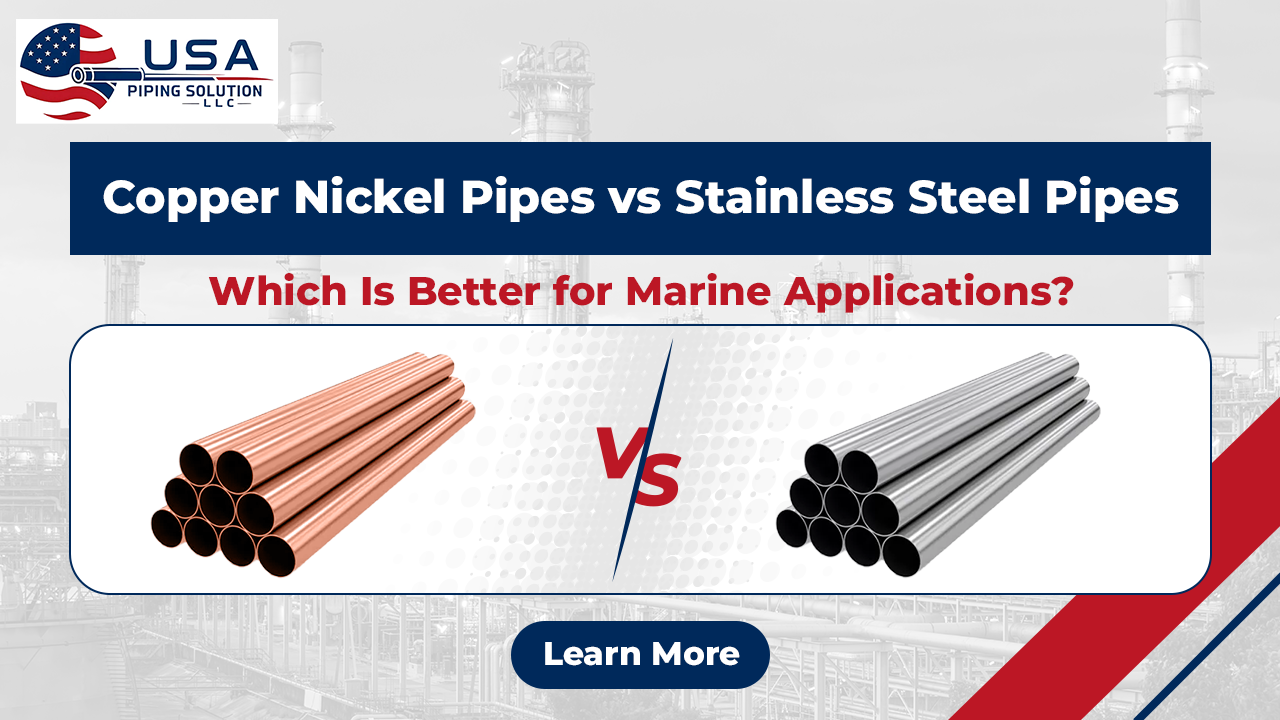
Any small failure in marine piping systems due to corrosion can close a vessel or offshore platform, and the most common cause is the wrong choice of pipe material. In a comparison of copper nickel pipes and stainless steel pipes in seawater applications, the corrosion differences in relation to the biofouling behaviour difference and the lifecycle cost difference are of paramount importance. Copper nickel pipes and tubes offer in-built defense against seawater corrosion and marine life, whereas stainless steel pipes rely on alloy constitution to offer strength and resistance to oxidation, and thus both will be useful as seawater-resistant pipes in particular situations. This paper assesses material grades, corrosion, cost-effectiveness, and marine applications as a means of making correct choices.
What Are Copper Nickel Alloy Pipes?
Copper-nickel alloy pipes (cupronickel pipes) are pipes of copper-based alloys that are made up of 10 to 30% nickel, particularly developed to be used in high-performance marine and seawater. Exposed to seawater, these copper-nickel pipes and tubes develop a light but stable layer of protective oxide, forming a natural preventive against corrosion, erosion, and biofouling giving the pipes and tubes long service under aggressive saline-water conditions. Copper Nickel 90/10 (C70600) is one of the most commonly used grades, providing a cost-effective compromise of corrosion resistance, ductile behavior and manufacturability including ASTM B466 (seamless) and ASTM B467 (welded), standards and flow limits are up to 3.36 m/s (continuous). Copper Nickel 70/30 (C71500), conversely, offers greater strength and better performance in high velocity and high-temperature seawater conditions, and is therefore used in such highly sensitive systems as submarines, offshore platforms, and desalination facilities, although at a more expensive material cost, and satisfies the same ASTM standards.
What Are Stainless Steel Pipes?
Stainless steel pipes are pipes made of iron alloys that have a minimum content of chromium of 10.5% and that are designed to be strong, resistant to corrosion, and durable in industrial, marine, and offshore situations. Exposed to oxygen, stainless steel develops a thin chromium oxide passive coating of its surface which inhibits general corrosion. This film, however, unlike copper-nickel can also be destroyed in stagnant or low velocity chloride environments and grade selection is of paramount importance in marine applications. The most widely used grade is the marine and offshore grade, grade 316L (S31603), which achieves superior pitting and crevice corrosion resistance through the addition of 2–3% molybdenum, and to comply with ASTM A312 (seamless and welded) with tensile strength of 520 to 750 MPa. Grade 304 (S30400) is also commonly applied in general industrial service although it lacks molybdenum content sufficient to be used in direct contact with seawater and is not recommended to be used in direct contact with hot seawater, where it is vulnerable to chloride-induced stress corrosion cracking (SCC).
Corrosion Resistance in Seawater — How These Materials Actually Compare
Corrosion performance is the decisive factor in marine pipe selection and the two materials fail in opposite ways, which is why grade and flow conditions must be specified together.
Copper Nickel Alloy Pipes
Copper-nickel alloy pipes develop a thin layer of cuprous oxide / cuprous chloride film in touch with seawater. This film is self-healing—when it gets damaged, it heals itself in hours. It is resistant to a large salinity and temperature gradient and has in-built resistance to biofouling: the natural toxicity of copper to marine organisms (barnacles, algae, mussels) renders the need of anti-fouling coating unnecessary. The most serious weakness is an impingement attack—when flow velocities exceed 3.36 m/s (continuous), the protective film may be eroded by turbulence or suspended solids, developing localised erosion-corrosion. This should be considered in design at bends, pump outlets, and elbows.
Stainless Steel Pipes
The stainless steel 316L provides a chromium oxide passive film, which is effective against general oxidation. The film is, however, susceptible to fracture in inert or slow-velocity chloride conditions, which occur in seawater ballast lines, cooling loops and idle offshore piping. The outcome is the corrosion pitting and, in hot seawater more than approximately 60°C, the chloride stress corrosion cracking (SCC). Stainless steel has no natural biofouling resistance and offers no anti-fouling advantage as compared to copper-nickel.
Mechanical Properties and What They Mean for Pipe Performance
Understanding how these materials perform under load, temperature, and flow conditions directly affects piping system design, wall thickness selection, and installation method. The table below summarises the key differences.
Property |
Cu-Ni (90/10) |
Cu-Ni (70/30) |
Stainless Steel 316L |
|---|---|---|---|
Tensile Strength |
300–380 MPa |
380–450 MPa |
520–750 MPa |
Yield Strength |
~100 MPa |
~170 MPa |
~205 MPa |
Elongation (%) |
30–40% |
30–40% |
40%+ |
Thermal Conductivity |
~50 W/m·K |
~29 W/m·K |
~16 W/m·K |
Max Flow Velocity (SW) |
3.36 m/s continuous |
4.5 m/s continuous* |
No limit (pitting risk at low velocity) |
Real-World Marine Applications — Where Each Material Is Used
Material selection in marine applications is rarely one-size-fits-all—the operating environment, pressure rating, diameter, and exposure type determine which alloy performs best in service.
Where Copper Nickel Pipes Are Used in the Marine Industry
In ships, copper-nickel 90/10 pipes are extensively utilized in seawater piping systems, condenser tubes, heat exchangers, and fire mains because of their good resistance to corrosion, and it is thus a common standard pipe to use in surface vessels. More difficult environments such as submarines and high-pressure systems, have copper-nickel 70/30 pipes due to their increased strength. The materials are also applied in offshore platforms and desalination systems, where there is constant contact with the seawater, and even in hull sheathing to minimise biofouling and maintenance.
Where Stainless Steel Pipes Are Used in the Marine Industry
For large-diameter structural piping on offshore platforms, 316L stainless steel is the standard specification under DNV-GL type approval, particularly where system pressure exceeds the practical range of copper-nickel pipe sizing. On chemical tankers and LNG vessels, stainless steel is preferred for cargo and process lines where acid resistance and full traceability to ASTM A312 are contractual requirements.
Cost Comparison — Copper Nickel vs Stainless Steel Over the Project Lifecycle
In comparing the copper nickel pipes compared to the stainless steel pipes, costs are determined by the entire lifecycle of the project and not the initial pricing. At smaller sizes, copper nickel can cost approximately 10% less than stainless steel, but 24% is more expensive than stainless steel at larger sizes. There are also differences in material pricing because copper is more volatile, whereas stainless steel (iron and chromium-based) is more stable, which are important during large-scale procurement.
Stainless steel is usually simpler to install, and less skillful labor is needed, whereas copper nickel is more sensitive to handling because it has thermal properties. But copper-nickel is superior in terms of operational costs, because it needs little maintenance in seawater, no anti-fouling coating necessary and fewer cleanings. Stainless steel, however, might require periodic inspection, cleaning and anti-corrosive measures.
In continuous seawater systems copper nickel usually provides better benefit over the long run because of reduced maintenance requirements particularly in smaller pipe sizes. Moreover, copper nickel can be recycled entirely and the production of stainless steel is more energy-demanding, which makes sustainability a bonus in the selection of materials.
Standards and Certifications for Marine Pipe Specification
Specifying the correct standard ensures the pipe meets minimum wall thickness, pressure rating, and alloy composition requirements for its intended service and is essential for naval, offshore, and desalination project contracts.
Copper Nickel Pipe Standards for Marine Use
In the case of copper nickel alloy pipes, ASTM B466 provides seamless pipes that are pressure, thickness and composition compliant to the severe marine applications whereas ASTM B467 applies to welded pipes in corrosion prone marine environments. MIL-T-16420 qualifies copper nickel tubing to be used in the U.S. navy ships and the reliability of the piping is long term, and the UK defence requirements on the reliability of CuNi piping in marine systems are set by DEF STAN 02-879.
Stainless Steel Pipe Standards for Marine Use
In the case of stainless steel pipes, quality and strength are established in ASTM A312 (seamless and welded pipes that are applied in marine and offshore environments) and ASTM A269 (general-purpose stainless tubing). EN 10217-7 provides that welded pipes are pressure and corrosion resistant, and the piping is certified as safe and can be used in any marine and offshore vessel by DNV-GL type approval.
How to Choose the Right Pipe Material for Marine Applications
In choosing between copper nickel or stainless steel pipes of the marine pipes corrosion resistant and the seawater resistant pipes, it is guided by the following decision based guidelines:
1. Continuous Seawater Exposure
When the flow velocity of the seawater is less than 3.36 m/s, the copper nickel alloy pipes (90/10) will be used (preferred) as they provide consistent corrosion resistance and a long service life with minimal maintenance.
2. Big-diameter or High-Strength Systems
In case your structure requires high mechanical strength, high-diameter piping, or high pressure (exceeding 40 MPa), it is better to use stainless steel 316L pipes because it has better structural performance.
3. Biofouling Resistance Requirement
In areas such as ship hulls, underwater cooling systems or offshore buildings with concerns of marine growth, copper nickel pipes are best since they are inherently resistant to biofouling rather than have to be coated.
4. Stagnant or Less Stagnant Seawater
When in situations where stagnant seawater or very slow moving seawater is observed, standard stainless steel should not be used because of pitting, but rather 316L stainless steel or copper nickel alloy pipes can be utilized to achieve greater life.
5. Chemical or Drinkable Water Uses
In case the system contains acids, chemicals or drinking water, the stainless steel pipes are used because of the chemical resistance and hygiene benefits.
6. Naval or Submarine Systems of High Pressure
In marine systems that use high pressure or submarines, it is better to use copper nickel 70/30 pipes as opposed to 90/10, due to their superior corrosion resistance and increased strength.
7. Lifecycle Cost and Environmental Consciousness
When long-term cost and sustainability are considered a priority, particularly in smaller-diameter systems, copper nickel alloy pipes should offer superior total cost of ownership because of low maintenance and recyclability.
Conclusion
Whether to use copper-nickel pipes or stainless steel pipes is a matter of choice and will depend on the flow conditions, pressure levels, diameter and lifecycle priorities of your application. In cases of sustained seawater exposure, biofouling performance and extended economical efficiency, copper-nickel alloy pipes, especially 90/10 and 70/30 alloys, are still the most favored product among global naval and offshore engineers. Where structural strength and chemical resistance are the important functions to be fulfilled, stainless steel 316L is used. It is worthwhile to make the specification correct initially to save on expensive failures in the future. For expert guidance and certified marine piping products across both grades, explore the full range at USA Piping Solutions or speak with our technical team to confirm the right specification for your project.
Frequently Asked Questions (FAQ)
What is the difference between copper nickel 90/10 and 70/30 pipes?
Copper nickel 90/10 (90% Cu, 10% Ni) is cost-effective, corrosion-resistant, and widely used in surface ship seawater systems. Copper nickel 70/30 (70% Cu, 30% Ni) offers higher strength and better corrosion resistance, making it suitable for demanding applications like submarines and desalination plants. Both follow ASTM B466 and B467 standards.
Are copper nickel pipes better than stainless steel pipes for seawater systems?
Copper nickel pipes are generally better for continuous seawater use because they resist corrosion, prevent biofouling, and don’t crack in chloride environments. Stainless steel 316L is preferred when high strength, large sizes, or chemical resistance are needed.
What are the flow velocity limits for copper nickel pipes?
For both 90/10 and 70/30 pipes, the safe limit is up to 3.36 m/s for continuous flow and 6.72 m/s for short-term use. Higher speeds can damage the protective layer and increase corrosion risk.
Which standards apply to copper nickel pipes in marine use?
ASTM B466 applies to seamless pipes and ASTM B467 to welded pipes. Naval standards include MIL-T-16420 (USA) and DEF STAN 02-879 (UK). Stainless steel pipes are usually specified under ASTM A312.
Is copper nickel more expensive than stainless steel?
It depends on size. Copper nickel is often cheaper for smaller pipes but more expensive for larger ones. However, it usually costs less over time due to lower maintenance and longer life in seawater.
Our Blog List
Application Industries
 Boilers
 Heat Exchangers
 Power Plants
 Steam Piping
 Refineries
Drop us a line
We respects customer privacy and ensures absolute confidentiality of any information that is given to us.