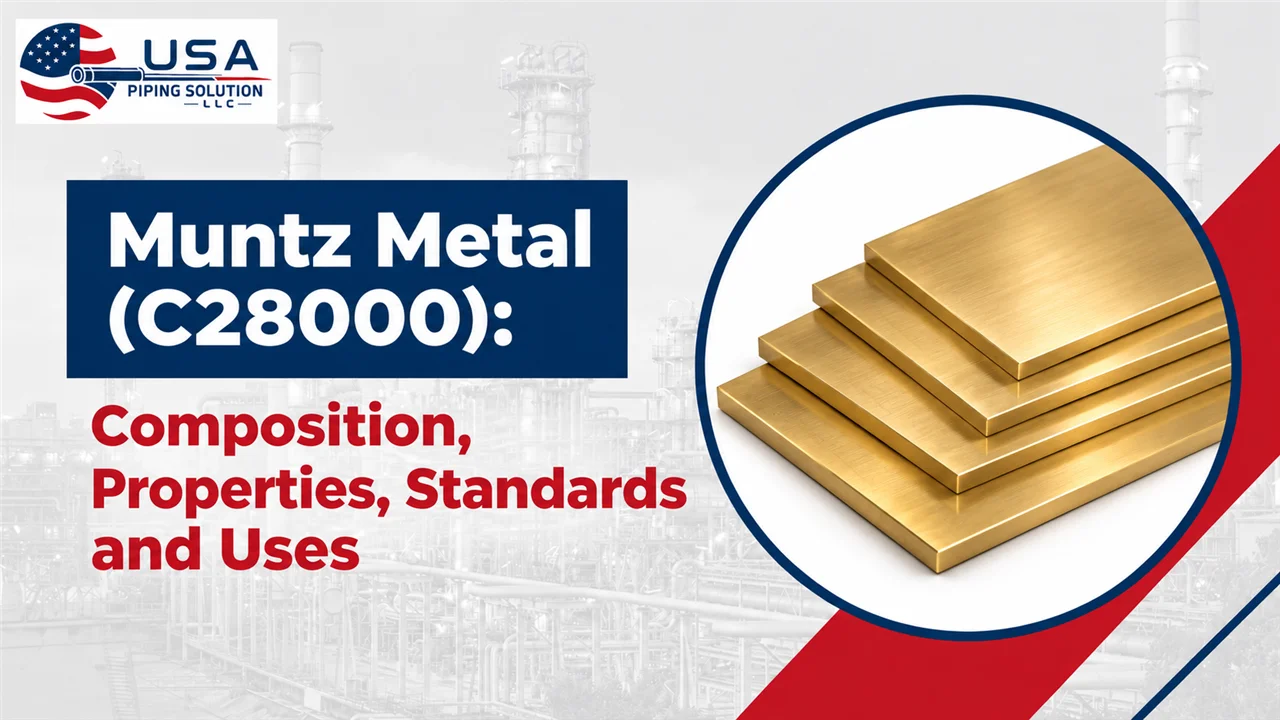
Muntz Metal (C28000) is a 60/40 copper zinc brass, patented in 1832 to be used in ship hull sheathing. It has a solid structure and is hot and workable, providing excellent strength, durability and value for marine, industrial and architectural uses. The seawater corrosion resistance, however, is moderate, and dezincification will happen under certain conditions. This guide lists the chemical composition of Muntz metal, its mechanical and physical properties, associated standards and typical applications, and when Muntz metal may not be suitable for a particular application, it may be preferable to consider using a naval brass or copper nickel alloy.
What is Muntz Metal?
Muntz Metal is a brass alloy consisting of about 60% copper and 40% zinc. Known as UNS C28000 or 60/40 brass/60/40 yellow metal, it is identified by this number. The alloy is called after George Frederick Muntz, who patented it in 1832 (verify the date and cite Britannica). Its alpha beta structure gives it excellent hot workability and good strength. Cold formability is only fair, so it is rolled, forged and extruded hot. While having only moderate cold formability, Muntz Metal can be rolled, forged and extruded at high temperatures. It is strong and economical, and is frequently used in marine, engineering and industrial applications.
Chemical Composition of Muntz Metal
The limits below provide muntz metal composition of chemicals according to ASTM B111 and theCopper Development Association record for C28000.
Element | C28000 limit (weight %) | Role in the alloy |
|---|---|---|
Copper (Cu) | 59.0 to 63.0 | Base metal; supports corrosion resistance, ductility and heat transfer |
Zinc (Zn) | Remainder (about 40) | Adds strength and forms the beta phase |
Lead (Pb) | 0.09 max | Residual element held to a low level |
Iron (Fe) | 0.07 max | Residual element held to a low level |
Copper plus the named elements must total at least 99.7 percent. Some older data sheets show 0.30 percent maximum lead; ASTM lowered the B111 limit to 0.09 percent in the 2008a revision.
Mechanical Properties of Muntz Metal (C28000)
ASTM B111 sets minimum strength for annealed (O61) condenser tube. The other rows are typical values from the Copper Development Association, useful for comparison but not guaranteed minimums.
Form and temper | Basis | Tensile, ksi (MPa) | Yield, ksi (MPa) | Elongation (%) | Rockwell hardness |
|---|---|---|---|---|---|
Tube, annealed O61 | B111 minimum | 50 (345) | 20 (140) | Not specified | Not specified |
Tube, light anneal O50 | Typical | 56 (386) | 23 (159) | 50 | F82 |
Tube, hard H04 | Typical | 74 (510) | 55 (379) | 10 | B80 |
Rod, soft anneal O60 | Typical | 54 (372) | 21 (145) | 50 | F80 |
Rod, quarter hard H01 | Typical | 72 (496) | 50 (345) | 25 | B78 |
Rod, as extruded M30 | Typical | 52 (359) | 20 (138) | 52 | F78 |
Flat product, hot rolled M20 | Typical | 54 (372) | 21 (145) | 45 | F85 |
Flat product, half hard H02 | Typical | 70 (483) | 50 (345) | 10 | B75 |
Yield strength is measured at 0.5 percent extension under load. Results change with section size and cold work. B111 supplies C28000 tube in the annealed temper unless the purchase order states otherwise.
Physical Properties of Muntz Metal
Property | Imperial | Metric |
|---|---|---|
Density | 0.303 lb/in³ | 8.39 g/cm³ |
Melting point, solidus | 1650 °F | 899 °C |
Melting point, liquidus | 1660 °F | 904 °C |
Thermal conductivity at 68 °F (20 °C) | 71 Btu/(ft·h·°F) | 123 W/(m·K) |
Electrical conductivity at 68 °F (20 °C) | 28% IACS | 16.2 MS/m |
Electrical resistivity | 37.0 ohm cmil/ft | 6.15 µΩ·cm |
Thermal expansion, 68 to 572 °F (20 to 300 °C) | 11.6 × 10⁻⁶ per °F | 20.9 × 10⁻⁶ per °C |
Specific heat | 0.09 Btu/(lb·°F) | 377 J/(kg·K) |
Modulus of elasticity | 15,000 ksi | 103 GPa |
Modulus of rigidity | 5,600 ksi | 38.6 GPa |
Looking for C28000 in tube form? See C28000 60/40 Muntz metal tubes or contact our team with your temper and quantity.
Different Standards of Muntz Metal (C28000)
Standard | Scope | Covers C28000? |
|---|---|---|
ASTM B111 / ASME SB111 | Seamless condenser tube and ferrule stock | Yes |
ASTM B135 / ASME SB135 | Seamless brass tube, round and rectangular including square | Yes |
ASTM B36 | Brass plate, sheet, strip and rolled bar | Yes |
ASTM B171 | Copper alloy plate for pressure vessels, condensers and heat exchangers | No; it lists leaded Muntz metal C36500 |
International Standards of Muntz Metal
System | Designation | Note |
|---|---|---|
ISO | CuZn40 | Verify against current ISO standard and product form |
EN | CW509L (CuZn40) | Verify against current EN standard and product form |
British (former) | CZ109 | Verify legacy BS designation and product form |
Japanese JIS | C2800 (also check JIS C2801) | Verify exact JIS designation and product form before ordering |
If your drawing calls for a condenser plate to B171, reviewC36500 brass as a separate grade and confirm the product form with your supplier.
Corrosion and Dezincification
Muntz metal performs well in ordinary atmospheres and many fresh waters, but its seawater resistance is only moderate. The main risk is dezincification.
Dezincification removes zinc selectively and leaves porous, weak copper. A part may keep its shape while losing strength or starting to leak. A pink or coppery patch on a yellow surface is a common warning sign.
Fabrication: Hot Working, Machining and Welding
Muntz metal is at its best when shaped hot. The recommended hot working range is 1150 to 1450 °F (621 to 788 °C). Its capacity for hot forming is rated excellent, with a forgeability rating of 90 against forging brass at 100.
Cold working capacity is only fair. Plan generous bend radii and anneal between severe forming steps. The annealing range is 800 to 1100 °F (427 to 593 °C). Consider stress relief after cold work if ammonia exposure is possible.
The machinability rating is 40, compared with 100 for free cutting brass C36000. Expect longer chips than a leaded brass produces, and set tooling and chip control to suit.
Joining method | Suitability |
|---|---|
Soldering | Excellent |
Brazing | Excellent |
Oxyacetylene welding | Good |
Spot welding | Good |
Butt welding | Good |
Gas shielded arc welding | Fair |
Coated metal arc welding | Not recommended |
Seam welding | Not recommended |
Zinc fumes form when brass is overheated, so provide proper ventilation and fume control during welding and brazing.
Uses of Muntz Metal
- Hull sheathing: Used as a low cost alternative to copper that resists marine growth.
- Ship bolts and fastenings: Used for ship bolts and fastenings because of its strength and low cost.
- Pier pile sheathing: The copper content helps deter shipworms on timber piles in marine environments.
- Condenser plates and tubesheets: Used for moderate strength and corrosion resistance in compatible water conditions.
- Heat exchanger and condenser tubes: Good thermal conductivity (approximately 123 W/m·K) suits heat transfer in compatible water conditions.
- Valve stems: Used in industrial valves because of its good strength and machinability.
- Large nuts, bolts and forgings: Suitable for hot forming into large fasteners and other industrial components.
- Marine and general hardware: Used for marine fittings and general hardware because of its strength and attractive yellow appearance.
- Architectural panels, door frames and trim: Used in decorative panels, door frames and trim for its warm golden colour and finish.
- Brazing rods:Used as a brazing filler material for joining compatible metals.
How to Choose the Right Alloy
Choosing the right brass alloy depends on its application, working conditions, and required properties. Muntz Metal C28000 is suitable for hot forming and general engineering, while naval brass C46400 offers better resistance to dezincification in marine environments. For heat exchangers, admiralty brass C44300 is commonly considered for freshwater service, whereas aluminium brass C68700 and copper-nickel alloys are options for seawater applications. Cartridge brass C26000 is a better choice for bending and deep drawing due to its good formability. For lead-free applications, always select a certified grade that meets the relevant standards and regulations. Water chemistry, temperature, and operating conditions should also be considered before final selection.
Frequently Asked Questions
What is Muntz metal made of?
Muntz metal is made of about 60 percent copper and 40 percent zinc. Under ASTM B111, C28000 contains 59.0 to 63.0 percent copper, no more than 0.09 percent lead and 0.07 percent iron, with zinc making up the remainder. No tin or arsenic is specified.
Is Muntz metal brass?
Yes. Muntz metal is a brass because zinc is its main alloying element. It belongs to the duplex, or alpha beta, family, which contains two phases at room temperature. This structure gives it excellent hot workability but lower cold ductility than 70/30 cartridge brass.
What is C28000?
C28000 is the Unified Numbering System designation for Muntz metal, a wrought 60/40 copper zinc brass. Close equivalents include ISO CuZn40, EN CW509L, former British CZ109 and Japanese C2800. It appears in ASTM B111 for condenser tube, B135 for seamless tube and B36 for flat products.
What is the difference between Muntz metal and naval brass?
Naval brass C46400 is a 60/40 type brass with 0.5 to 1.0 percent tin. Muntz metal C28000 has no specified tin. The tin improves resistance to seawater and dezincification, so naval brass is usually the better choice for marine hardware, although severe service still needs review.
Is Muntz metal good for seawater?
Only with caution. Muntz metal has moderate seawater resistance and can dezincify, especially in stagnant water, because its zinc rich beta phase is attacked first. Arsenic does not protect that phase. For continuous seawater service, consider naval brass, aluminum brass or copper nickel according to operating conditions.
Is Muntz metal magnetic?
No. Muntz metal is generally treated as nonmagnetic. Copper and zinc are not magnetic, and C28000 limits iron to 0.07 percent. A magnet that clearly sticks suggests another material, a steel core or surface contamination. Use chemical analysis to confirm the alloy.
Is Muntz metal lead free?
C28000 is not a zero lead alloy. ASTM B111 permits up to 0.09 percent lead, and some older references show 0.30 percent. Do not assume lead free compliance from the grade name. Compare the mill test report with the exact requirement that applies to your project.
What was Muntz metal used for?
Muntz metal was first widely used to sheathe the hulls of wooden ships, where it resisted marine growth at lower cost than pure copper. It also made ship bolts and fastenings and protected pier piles against shipworm. The clipper Cutty Sark is a famous example.
Our Blog List
Application Industries
 Boilers
 Heat Exchangers
 Power Plants
 Steam Piping
 Refineries
Drop us a line
We respects customer privacy and ensures absolute confidentiality of any information that is given to us.