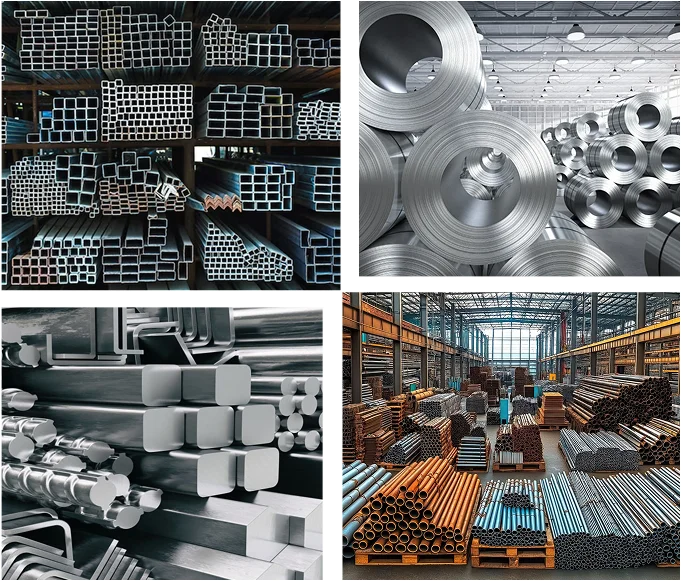
Round bars are a type of solid and long metal product that have a cylindrical shape. These bars are ordered according to diameter, length and grade of material. Steel bars are generally made by hot or cold rolled, forging, peeling, and grinding processes. These bars find their application in manufacturing shafts, pins, fasteners, fitting and parts of valves. This article describes the classification of round bars, discusses different grades of the bars, provides different sized bars and describes how to compute the weight of the bars using calculators and formulas. If you need to see complete range of product visit USA Piping Solution.
What Is a Steel Round Bar?
A steel round bar is a solid steel section with a uniform circular cross-section. It is commonly produced from carbon steel, alloy steel or stainless steel. Depending on the manufacturing process, it can have a scaled surface, a smooth bright finish or a precision ground surface.
Round bars are often confused with rods and reinforcement bars, but their applications are different.
- Round bar: General engineering material used for machining, fabrication, shafts, pins and fasteners.
- Rod: A term commonly used for smaller diameter or continuously supplied metal products. Its meaning can vary between industries and suppliers.
- TMT bar: Thermo mechanically treated reinforcement steel designed for concrete reinforcement. It is not interchangeable with engineering round bars.
Types of Round Bars
The types of round bars can be classified according to their manufacturing process, surface finish and material composition. Each type offers different dimensional characteristics and mechanical properties.
Types by Manufacturing Process and Finish
Process type | How it is made | Finish and accuracy | Typical use |
|---|---|---|---|
Hot rolled (black bar) | Heated steel rolled to size | Scaled surface, wider tolerance | Fabrication, general machining |
Forged | Heated stock pressed or hammered | Rough surface, improved grain flow | Large shafts, high load parts |
Cold drawn (bright bar) | Rolled bar pulled through a die cold | Smooth, close tolerance, higher strength | Pins, small shafts, CNC work |
Peeled or turned | Surface layer removed by cutting | Surface scale and defects removed | Larger machining stock |
Ground and polished | Ground, then polished | Closest tolerance, finest finish | Pump and precision shafts |
- Hot rolled bars are generally selected for fabrication and applications where a precision surface finish is not essential. They are economical and available in a range of diameters.
- Forged bars are suitable for larger components that require specific mechanical properties and controlled grain flow. They are often used in demanding industrial applications.
- Cold drawn bars offer better dimensional accuracy and surface finish than conventional hot rolled bars. They are useful where machining allowances need to be controlled.
- Peeled and ground bars are selected when surface quality, dimensional consistency and machining requirements are more demanding.
Types by Material
- Mild Steel and Carbon Steel Round Bars: These bars offer good machinability, weldability and strength for general engineering applications. Common grades include IS 2062, SAE 1018, SAE 1045 and EN8. They are widely used for shafts, pins, axles and fabrication components.
- Alloy Steel Round Bars: Alloy steel bars contain elements such as chromium, molybdenum, nickel and manganese to improve strength, toughness and hardenability. Common grades include EN19, EN24, AISI 4130, AISI 4140 and EN31. They are used in gears, heavy duty shafts, automotive parts and high strength fasteners.
- Stainless Steel Round Bars: These bars provide corrosion resistance and are suitable for applications involving moisture, chemicals and demanding operating environments. Common grades include SS 304, SS 316, SS 410 and 17 4PH. They are used in food processing equipment, chemical plants, marine components and industrial fittings.
- Duplex and Super Duplex Round Bars: Duplex grades combine high strength with corrosion resistance, particularly against chloride related corrosion. Common grades include UNS S32205, S32750 and S32760. They are commonly used in offshore installations, seawater systems and chemical processing equipment.
- Nickel Alloy Round Bars: Nickel alloys are selected for their ability to withstand severe corrosion, elevated temperatures and demanding industrial conditions. Common grades include Inconel 625, Monel 400 and Hastelloy C276. They are used in chemical processing, oil and gas equipment, heat exchangers and marine applications.
- Titanium Round Bars: Titanium offers a high strength to weight ratio along with excellent corrosion resistance. Common grades include Grade 2 and Grade 5. These bars are used in aerospace components, marine equipment, chemical processing and specialised engineering applications.
- Copper Nickel Round Bars: Copper nickel alloys offer good resistance to seawater corrosion and biofouling. Common grades include 90/10 and 70/30. They are widely used in marine piping systems, seawater cooling equipment, shipbuilding and offshore applications.
Steel Round Bar Grades
The table shows typical ranges in weight percent, and the order specification governs. Stainless grades are summarised here; see our guide to stainless steel round bar grades and sizes.
Grade | C, percent | Key alloys, percent |
|---|---|---|
IS 2062 E250 | Low | Structural grade, yield min 250 MPa in thinner sections |
SAE 1018 | 0.15 to 0.20 | Mn 0.60 to 0.90 |
SAE 1045 | 0.43 to 0.50 | Mn 0.60 to 0.90 |
EN8 (080M40) | 0.36 to 0.44 | Mn 0.60 to 1.00 |
4130 | 0.28 to 0.33 | Cr 0.80 to 1.10, Mo 0.15 to 0.25 |
4140 | 0.38 to 0.43 | Cr 0.80 to 1.10, Mo 0.15 to 0.25 |
EN24 (817M40) | 0.36 to 0.44 | Ni 1.30 to 1.70, Cr 1.00 to 1.40, Mo 0.20 to 0.35 |
EN31 (52100 type) | 0.90 to 1.20 | Cr 1.00 to 1.60 |
SS 304 | 0.08 max | Cr 18 to 20, Ni 8 to 11 |
SS 316 | 0.08 max | Cr 16 to 18, Ni 10 to 14, Mo 2 to 3 |
SS 410 | 0.08 to 0.15 | Cr 11.5 to 13.5 |
Duplex S32205 | 0.030 max | Cr 22 to 23, Ni 4.5 to 6.5, Mo 3.0 to 3.5 |
Equivalent Grades: EN, SAE and DIN
These are the closest equivalents, not identical grades. Confirm chemistry and mechanical properties before substituting.
BS (EN) | SAE / AISI | DIN / EN name | Werkstoff no. |
|---|---|---|---|
EN8 / 080M40 | About 1040 to 1045 | C40 / C45 | 1.0511 / 1.0503 |
EN19 / 709M40 | 4140 | 42CrMo4 | 1.7225 |
EN24 / 817M40 | 4340 | 34CrNiMo6 | 1.6582 |
EN31 | Close to 52100 | 100Cr6 | 1.3505 |
304S31 | 304 | X5CrNi18-10 | 1.4301 |
316S31 | 316 | X5CrNiMo17-12-2 | 1.4401 |
Weight Basics of Round Bars
Diameter | Carbon steel | SS 304 | SS 316 | Duplex 2205 |
|---|---|---|---|---|
6 mm | 0.22 | 0.22 | 0.23 | 0.22 |
8 mm | 0.39 | 0.40 | 0.40 | 0.39 |
10 mm | 0.62 | 0.62 | 0.63 | 0.61 |
12 mm | 0.89 | 0.90 | 0.90 | 0.88 |
16 mm | 1.58 | 1.59 | 1.60 | 1.57 |
20 mm | 2.47 | 2.49 | 2.51 | 2.45 |
25 mm | 3.85 | 3.89 | 3.92 | 3.83 |
32 mm | 6.31 | 6.38 | 6.42 | 6.27 |
40 mm | 9.86 | 9.97 | 10.03 | 9.80 |
50 mm | 15.41 | 15.57 | 15.67 | 15.32 |
63 mm | 24.47 | 24.72 | 24.88 | 24.31 |
75 mm | 34.68 | 35.03 | 35.25 | 34.46 |
100 mm | 61.65 | 62.28 | 62.67 | 61.26 |
125 mm | 96.33 | 97.32 | 97.93 | 95.72 |
150 mm | 138.72 | 140.13 | 141.02 | 137.84 |
200 mm | 246.62 | 249.13 | 250.70 | 245.04 |
Round Bar Weight Calculator
Use the calculator to find the weight of a round bar before you order. Choose the material, enter the diameter in mm and the length in metres, and add the quantity. The result is theoretical weight, and actual weight varies with the tolerance. Need a quote for the weight you have worked out?Request a round bar quote.
Round Bar Weight Formula
There is one formula for any metal, and a shortcut for steel.
- Any metal, metric: weight in kg = 0.7854 x D x D x L x density divided by 1000, where D is in mm, L is in metres and density is in g per cm3. The 0.7854 is pi divided by 4.
- Steel shortcut: weight in kg = D x D x L divided by 162, with D in mm and L in metres, for steel at 7.85 g per cm3.
- Steel, imperial: weight in lb = 2.67 x D x D x L, with D in inches and L in feet.
The 162 comes from 4 x 1,000 divided by (3.1416 x 7.85), which is 162.2. Do not use the 162 shortcut for non steel metals.
Uses by Industry
Industry | Parts made | Grades often considered |
|---|---|---|
General engineering | Shafts, pins, rollers, bushes | 1045, EN8, EN19 |
Fasteners | Studs, bolts, threaded bar | 4140, stainless, nickel alloys |
Automotive | Axles, gears, crankshaft parts | EN19, EN24 |
Oil and gas | Valve stems, flange parts | 4140, duplex, Inconel 625 |
Chemical processing | Pump shafts, fittings | 316, Hastelloy C276 |
Marine | Propeller and pump shafts, hardware | Duplex, Monel, copper nickel |
Construction and fabrication | Anchor bolts, tie rods, frames | IS 2062 |
Round bar is also the usual feedstock for studs and bolts, which is why it sits close to our bolting range. For the nickel alloy grades, see ourInconel round bars,Monel round bars andHastelloy round bars.
How to Choose the Right Bar
Work through these five steps:
- Load and strength: how much load must the part carry?
- Corrosion and temperature: what fluid or weather will it meet?
- Machining and welding: will you cut, turn or weld it?
- Delivery condition: annealed, normalised, quenched and tempered, or cold drawn.
- Standard and certificate: name the standard and say which certificate you need.
Choosing round bars comes down to grade, process, size and condition. Use the grade and size tables to shortlist, check weight with the calculator, and confirm the standard before ordering. Share your grade, diameter, length and quantity with USA Piping Solution, established in 2014, to request a quote and the applicable material test certificate.
Frequently Asked Questions
What is a round bar used for?
Round bars are machined into shafts, pins, studs and bolts, valve and pump parts and fabricated frames. The grade follows the service conditions, from IS 2062 for general fabrication to alloy, stainless or nickel grades for strength, corrosion or heat.
What are the main types of round bars?
By process, round bars are hot rolled, forged, cold drawn, peeled or ground. By material they are carbon, alloy, stainless, duplex, nickel alloy, titanium or copper nickel. The process sets the surface and tolerance, and the material sets strength and corrosion resistance.
Which grade of steel round bar is commonly used?
It depends on duty. IS 2062 suits general fabrication, EN8 or 1045 suits general shafts, and EN19 or 4140 suits parts that need higher strength. EN24 is chosen for highly stressed shafts and gears. Match the grade to load, wear and corrosion conditions.
What is the difference between a black bar and a bright bar?
Black bar is hot worked and carries a scaled surface and wider tolerance. Bright bar is cold finished, so it has a smoother surface, closer tolerance and higher strength. Choose black for fabrication and heavy machining, and bright for CNC work and precision parts.
What round bar sizes are available?
Commonly quoted metric diameters start at 6 mm and extend to 300 mm and larger forged sizes, while inch sizes start around 1/4 inch. Availability depends on grade and process, so check both before fixing a size on a drawing. Lengths of 3 m to 6 m are commonly quoted.
What is the formula for round bar weight?
For steel, weight in kg equals D x D x L divided by 162, with D in mm and L in metres. For other metals, use 0.7854 x D x D x L x density divided by 1000, with density in g per cm3. Both give theoretical weight.
Conclusion
Fix the grade from the service condition first, then pick the process that gives the finish and tolerance the part needs, and set the diameter with machining allowance included. Calculated weight is theoretical, so confirm the standard, tolerance and test certificate on the order.
USA Piping Solution, established in 2014, supplies industrial fastening products and specialty metal materials. Share your required grade, diameter, length and quantity to request a round bar quote.
Further study
Our Blog List
Application Industries
 Boilers
 Heat Exchangers
 Power Plants
 Steam Piping
 Refineries
Drop us a line
We respects customer privacy and ensures absolute confidentiality of any information that is given to us.