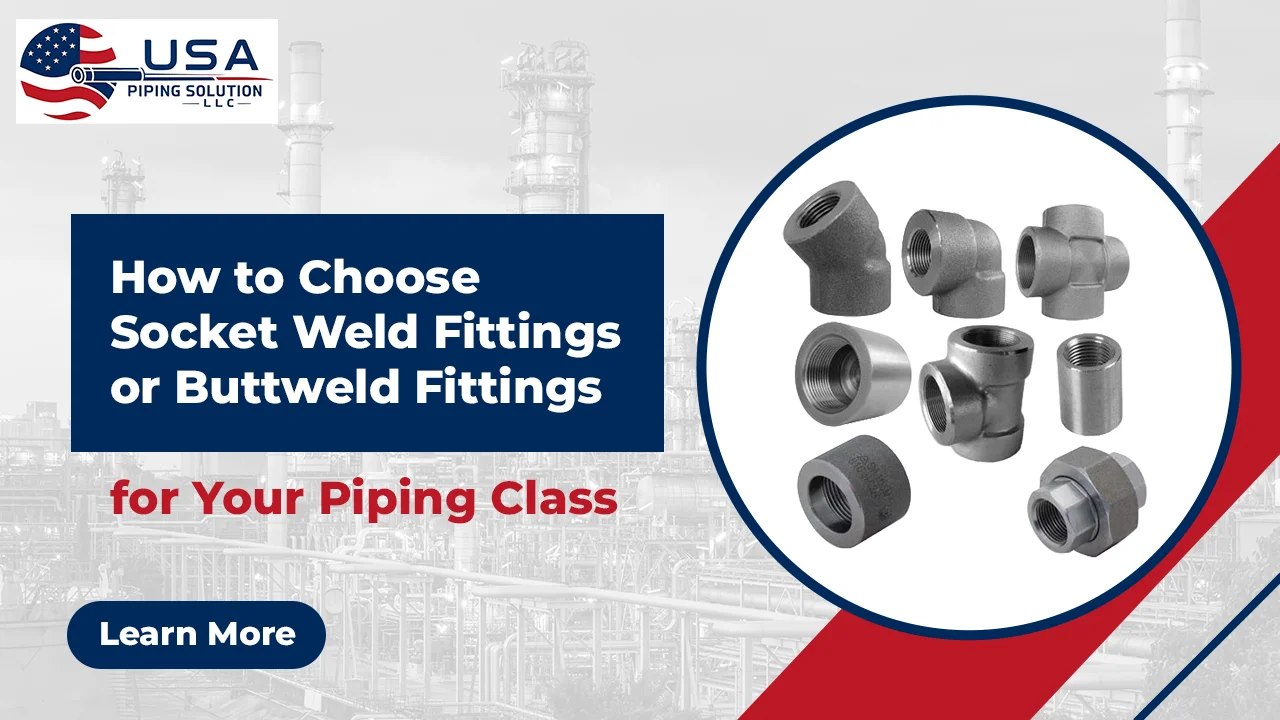
The choice between socket weld and buttweld fittings is usually settled by pipe size, service severity, and what your piping class actually permits. If those three factors align, the decision is straightforward. When they conflict, you need to understand the trade-offs before specifying anything.
USA Piping Solution stocks stainless steel buttweld fittings, stainless steel socket weld fittings, carbon steel fittings, and stainless steel forged fittings from audited mills, with nationwide stock and export capability.
What Each Joint Actually Looks Like
A buttweld fitting connects by beveling both the pipe end and the fitting end, then welding them face to face. The result is a full-penetration joint with a smooth internal bore and no pockets where fluid can sit or concentrate.
A socket weld fitting works differently. The pipe end slides into a machined socket in the fitting body, and a fillet weld is applied around the outside. A small gap of roughly 1/16 inch is deliberately left before welding rather than bottoming the pipe fully in the socket. That gap is intentional. It also creates a crevice, and we will come back to why that matters.
Buttweld vs Socket Weld Fittings Standards
Buttweld fittings follow ASME B16.9, the dimensional and tolerance standard for factory-made wrought buttwelding fittings. It covers a wide range of sizes and schedules.
Socket weld and threaded forged fittings both fall under ASME B16.11. That standard sets the class designations: socket weld fittings are Class 3000, 6000, or 9000. Threaded fittings under the same standard cover Class 2000, 3000, or 6000. A quick note on those class numbers: they are not a single psi rating. Actual allowable pressure and temperature depends on the governing piping code and the material group being used. Do not pull a class number out of context without checking the applicable derating tables.
For anyone specifying socket weld versus threaded, NPT thread geometry and gauging fall under ASME B1.20.1.
Socket Weld vs Buttweld Fittings Size Range
Socket weld is a small-bore solution. Most applications cap it at 2 inches NPS, and for practical reasons. Past that size, the fillet weld geometry stops delivering meaningful advantages and buttweld takes over. Buttweld covers the full range from small to large bore and is the default once pipe size increases or service consequences go up.
For available sizes and material grades across both joint types, see our pipe fittings and flanges and stainless steel pipe and tube fittings pages.
Side by Side Comparison
|
Factor |
Socket Weld |
Buttweld |
|---|---|---|
|
Standard |
ASME B16.11 |
ASME B16.9 |
|
Typical size range |
Up to ~2 in. NPS |
Small to large bore |
|
Pressure classes |
Class 3000, 6000, 9000 |
Full schedule range |
|
Bore profile |
Small crevice at socket |
Smooth, unobstructed |
|
NDT options |
Surface only (VT, PT, MT) |
Surface + volumetric (UT, RT) |
|
Fit-up time |
Faster, no bevel prep |
Requires bevel and fit-up plan |
|
Crevice/corrosion risk |
Present at socket shoulder |
Minimal, better for corrosive service |
|
Typical use |
Small-bore utility, instrument, high-pressure lines |
Oil and gas, chemical, high-consequence systems |
What Happens in Socket Joint Welding
The 1/16-inch gap at the socket shoulder is a design feature, not a defect. But it creates a dead space where fluid can sit. In clean, non-corrosive utility service, this is usually not a concern. Instrument lines, hydraulic connections, steam tracing on skids: that is where socket weld earns its place.
The calculation changes once the fluid carries chlorides, sees stagnant conditions, or leaves deposits behind. In those cases, the crevice concentrates attack and becomes a corrosion initiation site. That is the scenario that pushes the decision toward buttweld even when pipe sizes are small. Joint integrity in demanding services is also discussed in our guide on seamless vs welded pipe, where similar service-driven choices apply to base material selection.
Inspection access is the other factor. Buttweld joints support volumetric NDT methods including UT and RT, on top of surface methods like VT, PT, and MT. Socket weld geometry restricts volumetric access. If your piping spec or process safety plan requires full NDT coverage on a line, socket weld is typically ruled out at that point regardless of size.
Socket Weld vs Threaded: A Practical Note
Threaded fittings under ASME B16.11 offer the fastest assembly. No welding required, thread and make it up. That makes them useful for low-risk utility lines where disassembly is a real operational need. The trade-off is thread sealing. Vibration and thermal cycling can work joints loose over time, and stainless threads are prone to galling.
Socket weld removes those thread-sealing variables and handles vibration better. The trade-off is that you now need a qualified weld and cannot disassemble the joint without cutting. For any application with process fluids, moderate pressure, or vibration exposure, socket weld is the more reliable option compared to threaded.
Quick Decision Guide
Use buttweld when:
- Pipe size is above 2 inches NPS
- The service involves corrosive, chloride-bearing, or stagnant fluid
- Your piping class requires volumetric NDT coverage
- The system is oil and gas, chemical, power generation, or high-consequence
Use socket weld when:
- Pipe size is 2 inches NPS or smaller
- The service is clean, non-corrosive utility or instrument duty
- Fast fit-up is a priority and surface inspection is sufficient
- The piping class explicitly permits it for that specific line
If a utility line is later reclassified to process duty, or if corrosion inspection history shows deposit buildup, the joint type decision should be reassessed. That is worth flagging at the design stage.
For stainless options, our stainless steel fittings and flanges page covers available grades and specs. For carbon steel, see our carbon steel fittings and flanges page.
Making the Final Call
Socket weld and buttweld fittings serve different purposes within the same piping system, not competing options. Pipe size settles most of the decision first: above 2 inches NPS, buttweld is the practical default. Below that, the call depends on the fluid's corrosivity and your NDT requirements. Clean, non-corrosive service usually favors socket weld; chloride-bearing or stagnant conditions push toward buttweld even at small bore. Always check your piping class and line list before finalizing, and revisit the choice if a line's duty changes.
Check USA Piping Solution's socket weld fittings, buttweld fittings, and carbon steel fittings pages for specifications, grades, and stock availability.
USA Piping Solutions supplies ASME B16.9 buttweld and ASME B16.11 socket weld fittings from audited mills, with full EN 10204 3.1 / Mill Test Report (MTR) traceability. All carbon and stainless steel fittings are available with PMI verification on request.
Frequently Asked Questions
Is socket weld cheaper than buttweld for small bore piping?
Often yes on the fitting and labor side, since socket weld needs less bevel prep and less fit-up time. But the full cost comparison should include the corrosion and inspection risk over the line's service life. If the service is clean and non-corrosive, socket weld usually wins on total cost. If it's chloride-bearing or stagnant, the cheaper upfront install can get expensive once crevice corrosion shows up a few years in.
Can socket weld and buttweld fittings be mixed on the same pipeline?
Yes, this is common practice. A line can run buttweld through the main header where size and pressure are higher, then transition to socket weld on small-bore branch connections, instrument taps, or drain and vent lines. The piping class and line list should specify exactly where each joint type is permitted, so check those documents rather than assuming one joint type applies to the whole system.
Are socket weld fittings harder to repair than buttweld fittings?
In a sense, yes. A socket weld joint is harder to inspect from the inside because the geometry blocks most volumetric NDT, so a developing problem like crevice corrosion can go unnoticed until it leaks. Buttweld joints are easier to inspect and, if a defect is found, easier to cut out and re-weld cleanly because there's no socket shoulder to deal with.
What size pipe is too big for socket weld fittings?
Most piping classes cap socket weld at 2 inches NPS, with some specs allowing slightly larger sizes for specific services. Beyond that, the fitting and weld geometry stop making practical sense, and buttweld becomes the standard choice regardless of pressure class. If you're specifying above 2 inches, your piping class has almost certainly already ruled out socket weld for that line.
Our Blog List
Application Industries
 Boilers
 Heat Exchangers
 Power Plants
 Steam Piping
 Refineries
Drop us a line
We respects customer privacy and ensures absolute confidentiality of any information that is given to us.