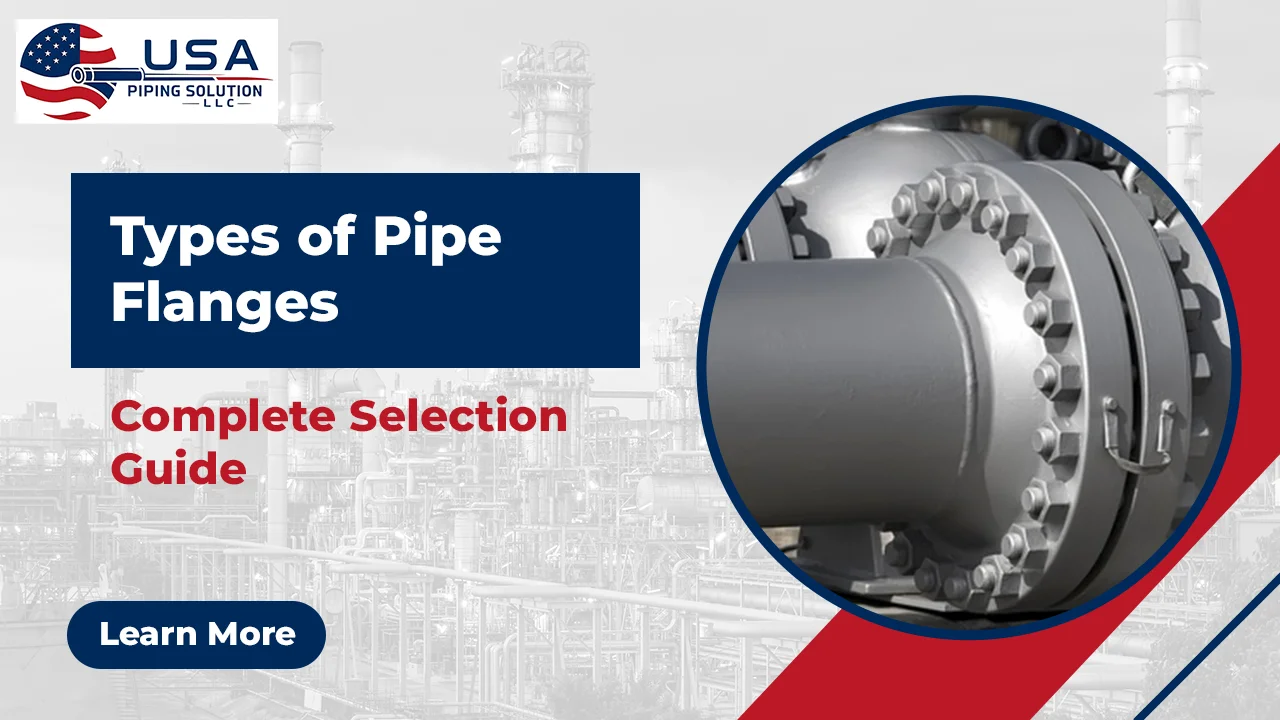
Pipe flanges are the most important component to connect pipes, valves, pumps, and other types of piping systems. The type of pipe flanges chosen according to designs, pressure requirements, and application sometimes makes the selection of this critical for system performance. These flanges ensure that the structure has secure pressure sealing, accurate alignment, and easy maintenance. There are various standards of these flanges, including ASME B16.5 and ASME B16.47, it comes in different dimensions, pressure classes, and ensures successful functioning. The most prevalent flanges are blind flange, weld neck flange, socket weld flange, slip-on flange and long weld neck flange. All these flanges are manufactured depending on the various industries such as oil and gas, petrochemical and power generation.
What are Pipe Flanges?
A pipe flange is a circular forged or cast disc with holes in it where bolts are to be fitted and with the holes drilled to allow the two parts of the pipe, valve or equipment to be attached to each other, providing a detachable and rigid joint in piping systems. Various kinds of pipe flanges are chosen depending on pressure, temperature, and use requirements, but they all have similar elements, including the face (sealing surface), bore (to match the inner diameter of the pipe), bolt circle (to hold them together), hub (to provide strength and stress distribution), and frequently a raised face to provide better sealing. Its working principle is founded on bolt load: as a gasket is clamped between two flanges that are bolted, the tightening force acts on the gasket to compress it, thus enabling it to accommodate surface defects and form a leak-proof seal even in extreme circumstances. The flanges are produced to the required standards, such as ASME B16.5 (1/2-inch to 24 inch), ASME B16.47 (large diameter, 26-60 inch), ASME B16.48 for line blanks, and MSS SP-44 for steel pipeline flanges, all of which define dimensions, pressure ratings, and material requirements for consistent performance across all types of flanges.
Types of Pipe Flanges
The pipe flanges are manufactured according to the different requirements of the industries. Some of the most common types of pipe flanges list is given below.
Slip-On Flanges
Slip-on flanges are the most common type of pipe flanges, which are slid over the pipe and then welded. Their bore size is a bit bigger than the pipe OD, which can be installed quickly and easily. The most important is the double fillet weld (internal and external) that gives it moderate strength and sealing. They are slip-on flanges that are most appropriate in low to medium pressure where precision in alignment is not a major factor. Their shortcoming, however, is that they are not as strong as a weld neck flange and thus not applicable in high-stress situations.
Weld neck flanges
The weld neck flange is easily recognized by the long tapered hub, which is butt-welded to the pipe. The design facilitates a free flow of stress between the flange and the pipe, which lowers the stress concentration at the joint. Among all types of flanges, it offers the best strength and durability, especially in high-pressure and high-temperature environments. These flanges find extensive application in such critical areas as refineries and power plants where reliability is paramount.
Blind Flange
A piping system or a pressure vessel opening is closed by a blind flange. It lacks a bore so it is perfect in isolating parts of piping. These flanges are usually applied in pressure testing, inspection and expansion in the future of the system. The reason is that blind flanges can be used in high-pressure applications that demand a secure seal due to their solid design.
Socket weld flanges
A socket weld flange has a socket that is recessed in which the pipe is inserted and then connected by a fillet weld. It is mainly applied in small-diameter piping systems that are under high pressure. It has a good internal flow and strength offered by this flange. Its disadvantage, however, is that it has a risk of crevice corrosion at the weld line and thus is not highly appropriate in highly critical or corrosive services.
Threaded Flanges
The threaded flanges are a special kind of pipe flange since they do not need to be welded. They are instead screwed on pipes which have external threads, and this makes their installation fast and convenient. These flanges are commonly applied to low-temperature and low-pressure systems like utility lines (air, water, nitrogen). They are mostly limited by their inability to work under high vibration or cyclic loading conditions.
Lap Joint Flanges
Lap joint flanges are installed with a stub end and can freely rotate around it. This design enables easy alignment of bolts and facilitates installation. They are best in systems that have to be dismantled frequently either to clean or be inspected. Although economical, particularly when high-priced materials are employed, they are not applicable in high pressure as compared to other forms of flanges.
Long Weld Neck Flange
The weld neck flange is extended with a long hub, which is used as a nozzle to reinforce it further. It is particularly formulated to be used in high-stress applications like pressure vessels and heat exchangers. It is also stronger and more evenly distributed in terms of load compared to a normal weld neck flange, thus it is suitable in a challenging industrial environment.
Flange Facing Types
The facing types in flanges determine how the sealing surfaces interact to achieve optimum leak-proofing. The three popularly used facing types include RF (Raised Face), which puts more pressure into a smaller area in order to ensure proper sealing of the gasket; FF (Flat Face), suitable for use in low-pressure systems because of their entire surface contact; and RTJ (Ring Type Joint), used in cases of high pressures and temperatures with a metal-to-metal seal type.
Materials Used in Pipe Flanges
Pipe flanges are made of different materials according to their temperature and corrosion resistance level. Some of the most common materials which are used to make these flanges are given below.
Carbon Steel Flanges
The reason why carbon steel flanges have become popular is because of their high level of strength and economic viability. The flanges operate satisfactorily at high levels of pressure and temperature and therefore find use in industries such as oil and gas, power generation, and general engineering applications. Carbon steel flanges are typical of Pipe Fittings and Flanges applications that do not face corrosion risks.
Stainless Steel Flanges
Stainless Steel flanges have been known to have great resistance to corrosion and with standability under difficult environments. They are best used in areas where there is moisture, chemicals, and high temperature like food processing, pharmaceuticals, and marine industries. Due to their long service life and low maintenance, Stainless Steel flanges are preferred in systems where hygiene and corrosion resistance are critical.
Exotic Alloy Flanges
Exotic alloy flanges have been developed to be used in environments that will require very harsh operating conditions and that cannot sustain conventional materials. They are made out of special alloys such as Inconel, Hastelloy, and Monel. The use of these exotic alloy flanges can be found in chemical processing, offshore plants, and advanced industrial applications.
Conclusion:
Pipe flange performance and reliability require the right choice of the type, the right choice of material and the matching to the particular conditions of application. Pressure rating, temperature exposure, and corrosion resistance are all important factors in determining the integrity of the system in the long term. The pipe flanges are of varying types and are tailored to diverse operation requirements and failure to select the right one might result to leakage, maintenance or system breakdown. At Usa Piping Solution, it is not about providing quality materials, but about engineering-based solutions to fit a particular project need. With a strong understanding of industry standards, materials, and real-world applications, the brand supports clients in selecting the right flanges for reliable and efficient piping systems.
Frequently Asked Questions
What are pipe flanges used for?
Pipe flanges are used to connect pipes, valves, pumps, and other equipment to form a piping system. They provide easy assembly, maintenance, and leak-proof sealing.
What are the main types of pipe flanges?
The main types include weld neck flanges, slip-on flanges, blind flanges, socket weld flanges, threaded flanges, lap joint flanges, and long weld neck flanges.
Which flange is best for high pressure applications?
Weld neck flanges are considered best for high-pressure and high-temperature applications due to their strong design and stress distribution.
What materials are used in pipe flanges?
Common materials include carbon steel, stainless steel, and exotic alloys such as Inconel, Hastelloy, and Monel, depending on application requirements.
What is the difference between RF, FF, and RTJ flange facing?
RF (Raised Face) improves sealing by concentrating pressure, FF (Flat Face) provides full surface contact for low-pressure systems, and RTJ (Ring Type Joint) is used in high-pressure applications with metal-to-metal sealing.
Our Blog List
Application Industries
 Boilers
 Heat Exchangers
 Power Plants
 Steam Piping
 Refineries
Drop us a line
We respects customer privacy and ensures absolute confidentiality of any information that is given to us.