Specifying the wrong pipe schedule at procurement results in rework, overweight material cost, or at worst, pressure failure in service. This guide explains how to read a pipe schedule chart, understand the NPS pipe size chart and select the correct schedule for your application.
What is a Pipe Schedule?
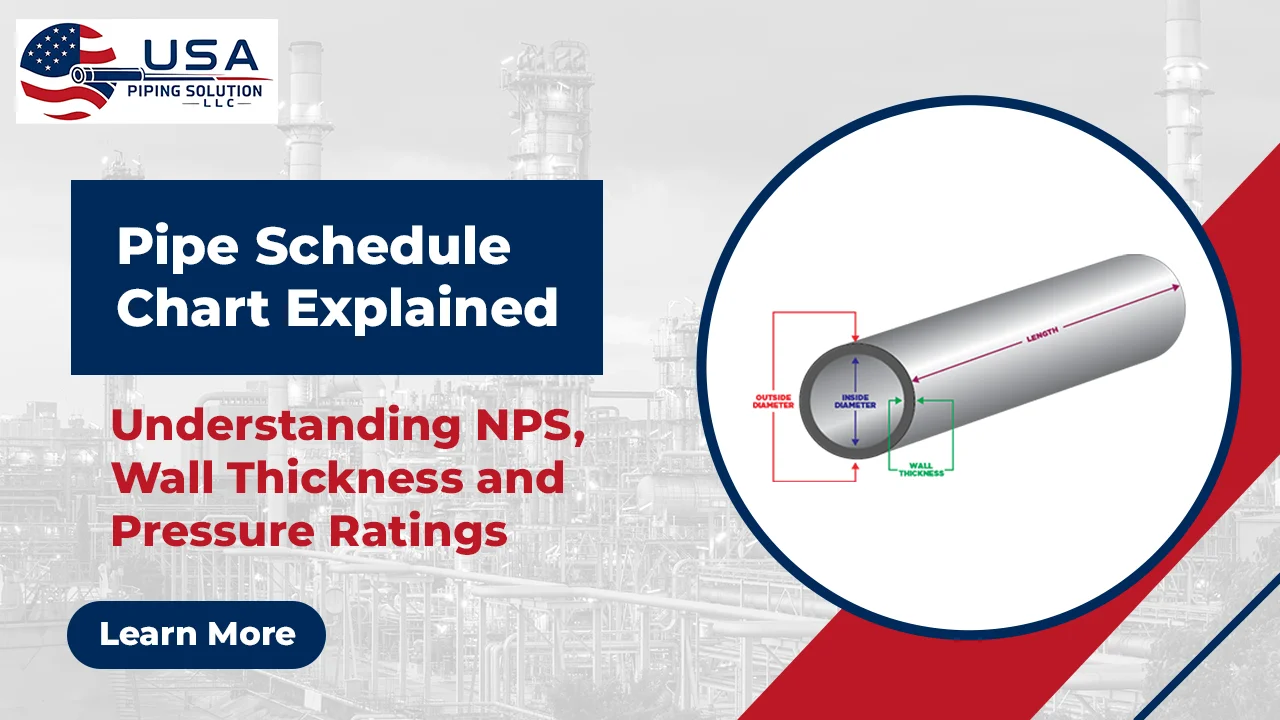
A pipe schedule is a numerical system that relates wall thickness of a pipe to its nominal size. The schedule number is not a true measurement. It's a reference code associated with a wall thickness of each nominal pipe size.
The core rule: the higher the schedule number, the thicker the pipe wall, and the greater the pressure-bearing capacity.
Four parameters define any row on a pipe wall thickness chart:
- Nominal Pipe Size (NPS): An ANSI and ASME designation size. Not the bore or OD of the bore. It is an alignment of specifications between manufacturers.
- Outside Diameter (OD): The external dimension of the product in inches or mm. For a fixed NPS, OD will remain the same for all time ratings on a schedule. There are only two changes, the wall thickness and inside diameter.
- Wall Thickness: The higher the number, the thicker the wall. The thicker the wall and smaller the bore the higher will be the schedule pipe.
- Pressure Rating: The maximum safe working pressure at a given temperature, set by schedule number and material grade.
ASME B36.10 and ASME B36.19: The Standards Behind Pipe Schedules
Two ASME standards govern steel pipe schedule specifications:
- ASME B36.10 covers carbon steel pipes, both seamless and welded, for industrial use. This is the primary reference for the ASME B36.10 pipe chart used in most carbon steel procurement. When sourcing carbon steel seamless pipes and tubes, B36.10 defines the applicable schedule dimensions.
- ASME B36.19 covers the stainless steel pipe schedule for seamless and welded stainless steel products. Wall thicknesses differ from B36.10 values for the same schedule number because material strength affects the required wall. Always reference B36.19 when ordering stainless steel seamless pipes and tubes.
How to Read a Pipe Schedule Chart
The pipe schedule chart is a grid that contains NPS, OD, wall thickness and schedule ratings. Important considerations:
O.D. is slightly larger than the nominal size for NPS 1/8 inch to NPS 12 inch. NPS 1 inch has an OD of 1.315 inches, not 1.000 inch. The size corresponds to the nominal size for NPS 14 inch and above.
For a given NPS, fittings are also interchangeable regardless of schedule, such as flanges and elbows, because the OD is always the same for the same NPS. The thickness of the walls increases in the direction of the bore; the bore decreases.
Many projects outside North America require a pipe schedule chart in mm. A 2-inch NPS Schedule 40 pipe has an OD of 60.3 mm and a wall thickness of 3.91 mm under ASME dimensional data expressed metrically.
Standard Pipe Schedule Chart: Key Sizes (ASME B36.10, in Inches)
|
NPS |
OD (in) |
Sch 40 Wall (in) |
Sch 80 Wall (in) |
Typical Application |
|---|---|---|---|---|
|
1" |
1.315 |
0.133 |
0.179 |
Light industrial, fluid lines |
|
2" |
2.375 |
0.154 |
0.218 |
Process piping, structural use |
|
4" |
4.500 |
0.237 |
0.337 |
Oil and gas distribution |
|
6" |
6.625 |
0.280 |
0.432 |
Chemical processing |
|
8" |
8.625 |
0.322 |
0.500 |
Heavy industrial, oil pipelines |
|
For complete schedule data across all NPS sizes, browse our full pipes and tubes catalogue. |
|---|
Common Schedule Ratings and What Each One Means
- Schedule 10: Thin-walled pipe for low-pressure water supply and non-critical industrial lines where weight and cost take priority.
- Schedule 40: The most widely used pipe schedule in industrial and commercial projects. Balances strength, weight, and material cost for water distribution, general process piping, and medium-pressure systems.
- Schedule 80: Thicker than Schedule 40, built for high-pressure oil and gas pipelines, chemical processing plants, and fire protection systems.
- Schedule 160: Heavy-duty rating for extreme pressure and high-temperature service such as steam lines and offshore drilling platforms.
For alloy steel seamless pipes in high-temperature service, schedule selection must also account for temperature derating of the specific material grade. To calculate pipe weight by size and schedule, see our weight formula for steel guide.
Schedule 40 vs Schedule 80 Side-by-Side Comparison
|
Feature |
Schedule 40 |
Schedule 80 |
|---|---|---|
|
Wall Thickness (NPS 1") |
0.133 in |
0.179 in |
|
Pressure Rating |
Up to 1,000 PSI |
Up to 1,500 PSI or higher |
|
Weight |
Lighter |
Heavier |
|
Cost |
Lower |
Higher |
|
Typical Use |
Water, general industrial piping |
Oil and gas, chemical, fire systems |
Specifying Schedule 80 where Schedule 40 is sufficient adds unnecessary cost. Using Schedule 40 in a high-pressure system creates a failure risk. Match the schedule to verified operating conditions.
How to Select the Right Pipe Schedule
Step 1: Define operating pressure. Systems up to 500 PSI: Schedule 40. Systems from 500 to 1,000 PSI: Schedule 80. Systems above 1,000 PSI: Schedule 160 or higher.
Step 2: Identify the fluid type. Corrosive or abrasive fluids erode pipe walls over time. A higher schedule adds wall margin for chemical and slurry service.
Step 3: Account for operating temperature. High temperatures reduce structural capacity. Steam and high-temperature process lines often require a higher schedule than pressure alone would suggest.
Step 4: Confirm standards compliance. Verify material and schedule against ASME B36.10 for carbon steel or ASME B36.19 for stainless steel pipe schedule requirements before ordering.
The Bottom Line
The selection of pipe schedule is not simply a rule of thumb, it is a calculated process based on fluid, temperature, pressure and standards. When you get the schedule wrong, you may be paying too much for the extra thickness or you may be in danger of a pressure failure. Take the data for the NPS, OD and wall thickness above as a starting point and check against ASME B36.10 or ASME B36.19 for the material specifications.
Looking for specific details of your project? View our complete pipes and tubes catagory for all schedule data for all sizes, or give us a call with your size, schedule and material requirements and we will be able to provide you with a quote that works for you.
USA Piping Solutions supplies carbon steel and stainless steel pipe in all schedule classes, with dimensional compliance to ASME B36.10 and B36.19 and full EN 10204 3.1 / MTR traceability. Our piping stock serves refinery, petrochemical, power generation, and industrial fabrication projects across North America and internationally.
FAQs
Does the outside diameter change if I order a higher schedule pipe in the same NPS?
No. The OD stays fixed for any NPS regardless of schedule. Only wall thickness and inside diameter change as schedule increases. Flanges, elbows, and fittings sized for that NPS will still fit correctly across all schedules.
Is Schedule 40 wall thickness the same for carbon steel and stainless steel pipe?
No. ASME B36.10 and B36.19 specify different wall thicknesses for the same schedule number. A Schedule 40 stainless pipe has a different wall than Schedule 40 carbon steel. Confirm which standard applies before ordering.
Can I get the pipe schedule chart in mm for metric project specifications?
Yes. All ASME pipe schedule data is available with OD and wall thickness in millimeters for metric project requirements. We provide full mm-based specification sheets on request. Contact our team with your NPS and schedule details.
Which pipe schedule is standard for oil and gas pipeline procurement?
Schedule 80 or Schedule 160 carbon steel per API 5L is typical. The exact schedule depends on operating pressure, pipe size, and design code. Always verify the specified schedule with your project engineer before placing a procurement order.
Our Blog List
Application Industries
 Boilers
 Heat Exchangers
 Power Plants
 Steam Piping
 Refineries
Drop us a line
We respects customer privacy and ensures absolute confidentiality of any information that is given to us.